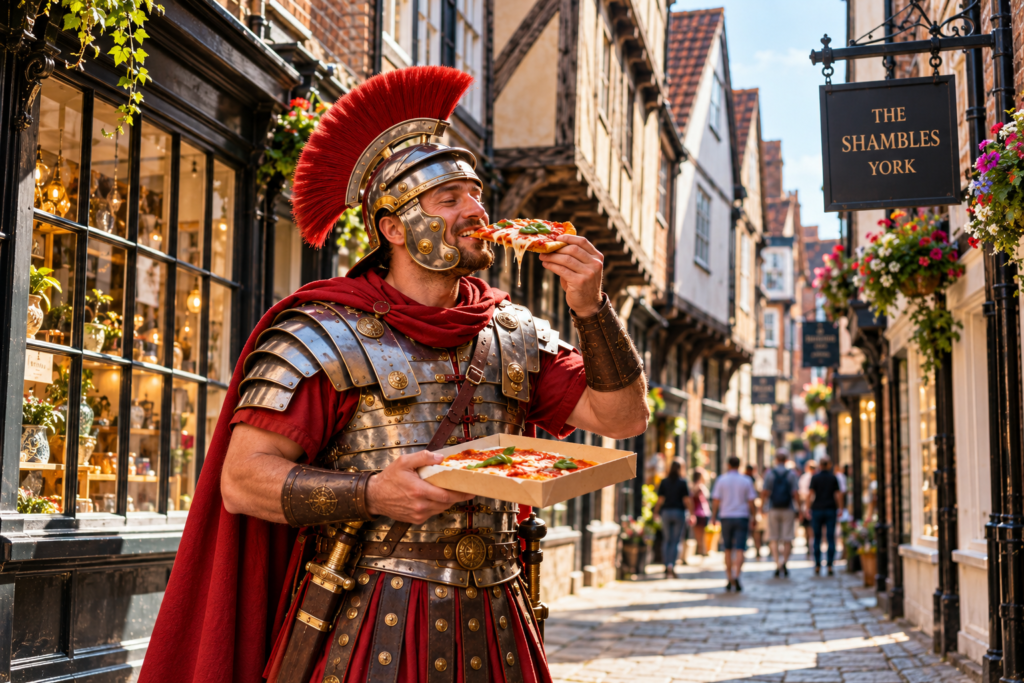
A customer recently asked us a question that brings two parts of York’s story together: did the Romans bring Italian cuisine to York? It is a lovely question for us at La Piazza Antica. The archaeological evidence gives us a nuanced answer: Roman York had access to some foods from the Mediterranean, but its cuisine was not modern Italian food transplanted wholesale. Much of the everyday diet was local, and the building where we welcome guests today belongs to a later chapter of York’s history.
Food in Roman York
The Romans called York Eboracum. A legion established a fortress here in AD 71, and a civilian settlement grew across the River Ouse. By the early third century, York had become a colonia, a prominent self-governing Roman city. Its position and status connected it to people and goods moving across Britain and the wider empire. [1]
Most meals, however, depended on food close to home. Archaeological evidence from York suggests cereals were everyday staples, eaten as bread and porridge, alongside beef, mutton, pork and chicken. Fish and crab also feature in the picture: herring could come from the Humber, while crab was available from the Yorkshire coast. The remains even include a dormouse, a prized delicacy in Roman dining. [2]
These finds remind us that “Roman food” was not one fixed menu. Diet varied with income, location, season and access to trade. A soldier, a local craftworker and a wealthy household would not necessarily have eaten alike. York’s evidence reflects both the surrounding countryside and a city that drew people and provisions from farther away.
Ingredients and trade from the Mediterranean
Some foods travelled much longer distances. The History of York’s account of Roman diet notes olives, grapes, wine and figs among imports reaching the city from the continent. [2] Excavated amphorae — large transport jars — add detail to that trading picture. York Archaeological Trust’s study of pottery from the colonia describes goods arriving from several regions of the Roman Empire, with Spanish olive oil and French wine especially prominent. [3]
Plant remains call for a little care in how we tell the story. A specialist study of environmental evidence from Roman York identifies olive as a clearly imported plant product, while noting that the origins of some other fruits are less certain: grapes or figs might sometimes have been grown locally, and preserved fruit may also have been imported. [4] Archaeology can reveal what reached a place, but it does not always tell us exactly where each item was grown or how often it appeared on the table.
So, did Roman York taste “Italian”? In one limited sense, York shared ingredients and habits with the wider Roman world, whose cultural centre lay in the Mediterranean. But the evidence points to a connected empire, not to modern Italian cuisine arriving fully formed. Some imports came from regions that are now Spain or France; much of the daily diet was local; and food culture changed over centuries. “Roman” is the more accurate description than “Italian”.
The connection to York’s Italian dining scene today
For a more immediate Italian connection, we welcome guests at 45 Goodramgate. The building around our restaurant tells a different, much later story from Roman York. Historic England lists 41, 43 and 45 Goodramgate as Grade I, dating the group to around 1500 and noting an early seventeenth-century extension. Its entry records that No. 45 was restored in 1929 and that a substantial amount of the timber frame survives. [5] York Conservation Trust likewise describes the Tudor townhouses at 43–45 as built around 1490. [6]
Our restaurant’s history page notes that the building has also served as a bakery and grocery store. [7] We love that our guests can enjoy Italian food in a timber-framed building with such a rich York story. That is the connection we can make with confidence: a contemporary Italian dining experience in a historic English setting, not a claim that this house — or our restaurant — descends from a Roman eating place.
Our answer to our customer is: the Romans brought Roman culture and Mediterranean trade connections to York, and some imported foods reached the city. But the evidence does not show that they brought Italian cuisine in the modern sense. What it does show is that York’s food story has long been shaped by local ingredients and connections beyond the city — a story we are glad to continue, in our own way, at La Piazza Antica.
